Heron Habitat Helpers

Enjoy, Learn, Protect.

  • Home
  • About
    • Mission
    • History
    • Archives
    • Newsletters
    • 2015 Accomplishments
    • 2016 Accomplishments
  • Volunteer
  • EVENTS
  • Herons
    • Heron Facts
    • Heron Watching
  • Restoration
    • Kiwanis Ravine Overlook (KRO)
    • Kiwanis Ravine Stevens (KRS)
    • Kiwanis Wildlife Corridor (KWC)
    • Commodore Shore (CS)
    • Commodore Grove (CG)
  • Blog
  • Resources
  • Donate

Heron FishingGreat Blue Herons are fascinating birds that can live up to 20 years. These majestic animals need human help to ensure their habitat in Kiwanis Ravine and other urban areas is protected and properly managed. In addition to the colony in Kiwanis Ravine, Seattle is home to heron colonies in the North Beach neighborhood, the West Marginal Way Greenbelt, Matthews Beach, and the University of Washington campus. Washington also hosts heron colonies in the Black River Riparian Forest of Renton and on Samish Island near Bow, at the mouth of the Skagit River valley. Herons hunt for fish at the Locks near Kiwanis Ravine and along Puget Sound and Lake Washington shorelines. Year after year, the herons return to their nests in February and spend several weeks in courtship to select a mate for the season. The female typically lays three to five eggs, which both parents alternate incubating for about 28 days. Heron chicks typically fledge in two months, usually in June or July. However, young from late nests may not fledge until late summer. During an undisturbed season, two to four chicks typically fledge per nest.
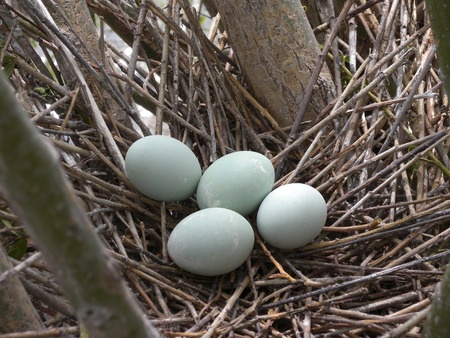
Heron Eggs
Great Blue Heron Eggs

Until 2013, the majority of herons at Kiwanis Ravine nested in maple and alder trees on the west side of the ravine. That year, due to eagle predation, the herons moved mid-season to Commodore Park, where 6 nests already existed. Herons built approximately 55 nests, and continue to nest there each season. Although herons can be very sensitive to noise disturbance, the herons that nest in Commodore Park have chosen a much more exposed nesting area and seem oblivious to people passing by or the numerous boats traveling through the Ballard Locks or the trains crossing the railway bridge.

The heron which those at HHH work so hard to protect is an iconic bird, embodying a curious set of contradictions. Its gangling body seems like a feathery bag of ungainly limbs – yet it fishes with a dexterity, precision and streamlined grace that belies its scruffy appearance. The dangle-legged flight of the heron has an almost comedic awkwardness – yet the still, stoic concentration and swift, skilled strikes of the heron when fishing gives precisely the opposite impression.

Heron Catching Bass
Heron Fishing

It is perhaps little wonder that this unique creature has so captured the human imagination over the centuries. Few birds have acquired such a wealth of symbolic significance and folkloric belief. It was believed, for example, that great blue herons and their closely-related old-world counterparts, grey herons, would nibble at the feathers of their breasts when fishing. This, people thought, would produce a luminous powder which the birds sprinkled upon darkened waters to illuminate their prey. In fact, the heron does have powder deposits upon it breast, but it uses these to clean and condition its feathers rather than to light up startled fish. So willing, however, were people to believe strange and wonderful things of this enigmatic bird that the belief persisted right up until the twentieth century, with even reputable naturalists reporting upon it.

Volunteer Opportunities

It's not all digging in the dirt!

Let us know what piques your interest and skill set. We're open to your ideas so don't hesitate to contact us to chat. Some current needs are:

• Monitor the colony - We’re looking for enthusiastic citizen scientists who will volunteer to observe and record data on a large colony of great blue herons next to the Ballard Locks in Seattle. Volunteer hours will be a minimum of once/week, three hours/day during heron breeding season – March to early August. No previous experience necessary. We will train.

• Content creation - We'd love to post your articles and photos on our website and social media pages. We're open to subjects about birds - especially herons, native plants, your nature volunteer experiences, etc. Submit your ideas or contact us for more info!

• Reaching out - Help us increase our presence in the community. We plan on having a table at a few farmers markets over the summer and hosting special events. We could use a hand!

• WordPress Website expertise - Help us update content, improve navigation, and make it easier for visitors to connect with our mission.

• Get on Board - HHH is looking for passionate people who want to be on the Board. Work with us to promote our mission and grow HHH into the future.

Subscribe to our Newsletter!

Collaboration

HHH works with Seattle Parks and Recreation Department (Parks), www.seattle.gov/PARKS, to restore, maintain, and monitor Kiwanis Memorial Preserve Park. We interface and share projects with Parks in the Habitat Advisory Panel (HAP) committee. Also, we are a member of the Green Seattle Partnership (GSP),www.greenseattle.org, a partnership between the City of Seattle and the Cascade Land Conservancy. The City of Seattle is represented by the Department of Parks and Recreation, Seattle Office of Sustainability and Environment, and Seattle Public Utilities. The partnership goal is to restore all of Seattle's forested park lands by 2025. We are one of the many non-profit organizations supporting this effort.

In addition, HHH is part of the Great Blue Heron Working Group, a consortium of citizens and scientists organized by the Washington Department of Fish and Wildlife, WDFW. The group has participation from scientists as far north as Protection Island, B.C. (near Nanaimo, B.C.) and as far south as Olympia, WA. One of the scientists from that Heron Working Group is Ann Eissinger, and she has formulated a protocol for studying heron colonies. In that protocol is an in depth study about the life cycle of the great blue heron. To read the study, please click HERE. HHH is working to establish a sense of community throughout this region, called the Salish Sea, focused on appreciation and support for the Great Blue Heron.

Heron Watching

Great Blue Herons can be seen courting and nesting between February and August. We encourage you to visit Commodore Park to see the nesting birds during these months. Kindly watch quietly and carefully during this very sensitive time so as not to disturb these lovely creatures. Remember, this is their home. In addition to the newly expanded great blue heron colony in Commodore Park, other colonies in the greater Seattle area are located on the University of Washington campus, at Marymoor Park in Redmond, and in the City of Kenmore.

Heron Habitat Helpers is attempting to learn about new nesting locations and will provide periodic reports. Residents who spot herons flying with twigs and small branches in their bills, a sign of nest building, are encouraged to report these sightings to info@heronhelpers.org.

Heron Facts

  • The Great Blue Heron’s long legs allow it to hunt in deeper water than most other herons and egrets.
  • Herons can swallow a fish many times wider than its narrow neck.
  • Herons look for food anytime there is enough light. Studies suggest that cloudy weather is ideal for the birds to look for fish.
  • Adult herons stand around three feet tall, but can stretch to about four feet.
  • Their wingspan is about six feet, yet these birds weigh only about 5 to 6 pounds.
  • In flight Great Blue Herons average about 25 mph, their maximum flight speed can approach 35 mph.
  • Herons often reuse a nest, adding sticks to it each year.
  • The male brings sticks and the female works them into the nest.
  • Herons lay from three to seven eggs, but the usual number is four.
  • Heron chicks are often aggressive toward each other, and some are pushed from the nest.

Kiwanis Ravine Support

Kiwanis Ravine is a natural area that sits close to the eastern edge of Seattle's Discovery Park. The ravine was formed by two drainages coming from the east and west forks of Wolfe Creek. Very little is left of those drainages today, but what remains does channel water down through Kiwanis Ravine toward the Lake Washington Ship Canal, where it is intercepted and piped to West Point, a nearby wastewater treatment plant. The ravine is home to many species of birds, plants, and animals, particularly the Great Blue Heron. In 2010 the ravine hosted approximately 80 successful heron nests. Supporting the herons through restoration of their native habitat is paramount to our mission. However, Kiwanis Ravine is so steeply sloped, the City of Seattle cannot allow the general citizenry, or HHH volunteers, to do restoration work on the steep slopes of the ravine, so specialized contractors, like EarthCorps, are hired to work these areas. Three areas with no significant slope allow volunteer access; Kiwanis Ravine Overlook (KRO), Kiwanis Ravine Stevens (KRS), and Kiwanis Wildlife Corridor (KWC). Please click here to see those areas identified on the map.

Recent Posts

  • April 11, 2026 – 9am – 1pm – Second Saturday Habitat Restoration at Kiwanis Ravine Corridor in Magnolia March 12, 2026
  • Be Part of a Forest’s Future! September 3, 2025
  • What’s Up at the Colony April 3, 2025
  • Sun. June 2, 2024 – 10am – 1pm Annual Heron Chick Birthday Celebration! May 16, 2024
  • Heron Chicks Hatched!! May 1, 2024

Categories

  • BLOG
  • Colonies
  • Courtship
  • Donations
  • Events
  • Heron Nests
  • Herons
  • Membership
  • Native Plants
  • Nesting
  • News
  • poster contest
  • Uncategorized
  • Volunteer

Nonprofit Status

Heron Habitat Helpers is an IRS 501(c)(3) organization under the umbrella of the Associated Recreational Council (ARC), IRS #51-0170717. Visit ARC at www.arcseattle.org.

Associated Recreational Council
100 Dexter Avenue North
Seattle, WA 98109-5102
206-684-7083

Get Social

Membership

By becomming a Member and supporting HHH, you are directly contributing to conservation initiatives, habitat restoration efforts, and educational programs. Join now!

Volunteer

There are many ways to get involved with HHH! Please email us for a list of current opportunities. 
volunteer@heronhelpers.org

Contact Us

Heron Habitat Helpers
4574 36th Avenue West
Seattle, WA  98199-1146
info@heronhelpers.org

Copyright © 2014 - 2026 · Heron Habitat Helpers